
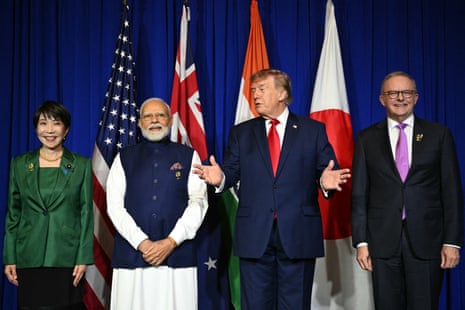
Trump meets with Japan, Australia and India leaders in Manila
Donald Trump is meeting with the other leaders from the so-called Quad, a group of nations including the US, Australia, India and Japan that has aimed to counter China’s influence in the Asia Pacific.
The US president will talk with the Indian prime minister, Narendra Modi, the Australian prime minister Anthony Albanese and the Japanese prime minister Sanae Takaichi at the Solaire hotel in Manila. We will bring you his comments shortly.

Key events
Rebecca Bailey
Rebecca Bailey is the Guardian’s China correspondent
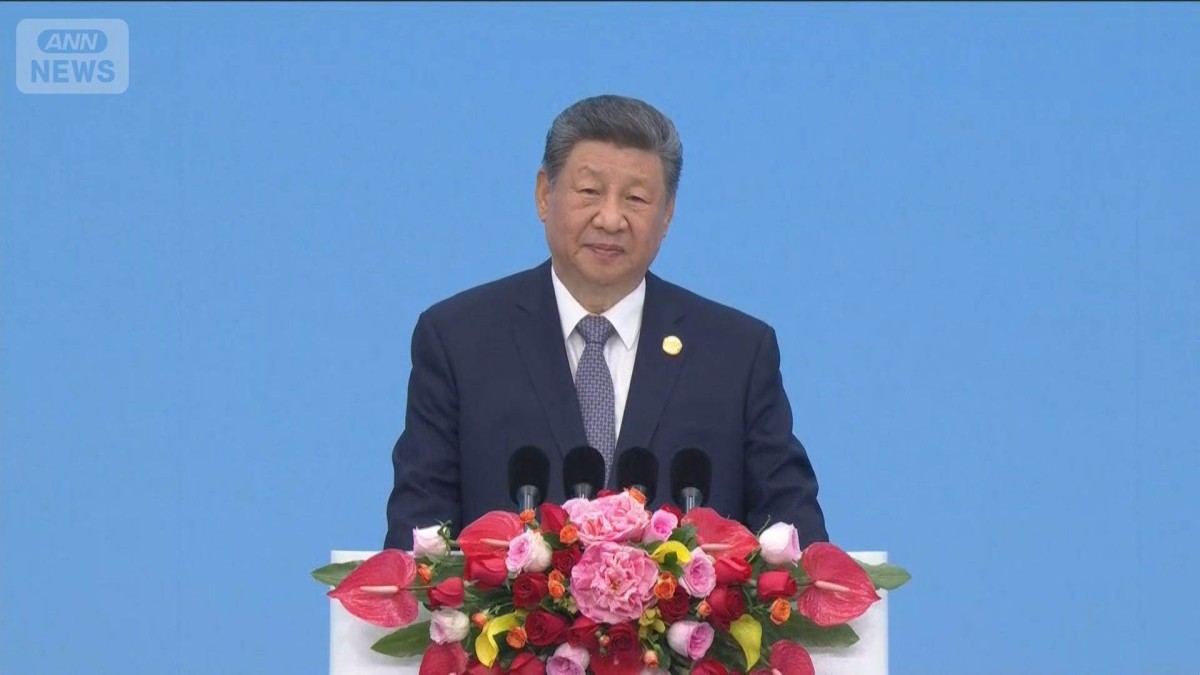
Here in Shenzhen, the Apec CEO summit has wrapped for the day. Xi Jinping’s keynote address will be tomorrow it seems, though no detailed official schedule has been released yet.
After handing over the chair of Asean to Singapore, the Philippines president, Ferdinand Marcos Jr, held a brief news conference in which he told reporters: “President Trump has just arrived.”
“He is waiting for us to go to him and to invite him to this really very informal kind of summit.”
According to the NY Times, Marcos Jr then apologised for not answering more questions, explaining: “I cannot keep the president of the United States waiting … Sorry.”
Kim Jong-un ‘would like’ to come to Apec summit in China, Trump says
Before the four Quad leaders read out their pre-prepared remarks at the roundtable in the Solaire hotel, Donald Trump took a few questions from journalists, which we are just catching up on now. Here are some of his comments:
-
Trump said that North Korean leader Kim Jong-un “would like” to come to the Apec summit in the southern Chinese city of Shenzhen, hours after Beijing said it had no information about an encounter between the two.
-
Trump said he would take a separate bilateral meeting with Russian President Vladimir Putin at the upcoming Apec summit “if it’s available”.
-
Trump said he will press Chinese President Xi Jinping and Putin on the war on Iran “to get involved, to get it ended”.
-
Trump said he would be “looking into” reports of plans by the Iranians to potentially detonate a so-called “dirty bomb” in Washington.
Australian prime minister Anthony Albanese said the leaders will talk in their closed discussion about the development of critical minerals/rare earths and the AI revolution, with maritime security also high on the agenda. The press has left the room now to allow the Quad grouping to talk privately.
Japan’s prime minister, Sanae Takaichi, said the Quad will help shape the future of the Indo Pacific. She said:
We would like to realise a free and open Indo Pacific by strengthening resilience of countries in the region and promote their freedom to decide for themselves across a wide range of areas including maritime security, economic security, energy and critical and emerging technologies.
Takaichi added that she will speak in more detail after journalists have left the room.
Indian prime minister Narendra Modi said since January 2025 the Quad’s foreign ministries have met five times, showing the strength in the partnership.
He said the Quad helps with maritime security in the region and thanks the three other leaders personally for their efforts to advance the grouping. Quad leaders last met in September 2024 in Delaware.
Trump says the four Quad countries are, in some ways, among the most successful and powerful in the world. “Our countries are the four corners of a free, open, stable and prosperous Indo Pacific,” he said, adding that the grouping coordinate closely on matters of security and diplomacy.
Trump announced that the Quad will conduct an exercise involving US maritime patrol aircraft which he claims will “protect peace through strength”.
Trump meets with Japan, Australia and India leaders in Manila
Donald Trump is meeting with the other leaders from the so-called Quad, a group of nations including the US, Australia, India and Japan that has aimed to counter China’s influence in the Asia Pacific.
The US president will talk with the Indian prime minister, Narendra Modi, the Australian prime minister Anthony Albanese and the Japanese prime minister Sanae Takaichi at the Solaire hotel in Manila. We will bring you his comments shortly.
The prime minister of Singapore, Lawrence Wong, has just said his country has accepted the chair of Asean from the Philippines and will host the gathering next year (the regional bloc rotate chair annually).
“Next year we will mark the 50th anniversaries of Asean’s relations with the US, with Canada and the EU, as well as the 30th anniversary of the Asean plus three (China, Japan and South Korea). These are opportunities to deepen practical cooperation and reinforce Asean’s role as an open and inclusive platform for engagement,” he said at the summit’s closing ceremony.
“We hope to work closely with all of you in Asean and across all our partners to build an Asean that is united in its purpose, confident in its future and open to the world.”
China slams new US chip curbs and pledges ‘necessary measures’

Graeme Wearden
China has threatened to retaliate against the US after Washington tightened restrictions on remote access to AI chips and servers.
At a press conference on Tuesday, China’s foreign ministry spokesperson Guo Jiakun said Beijing would take “necessary measures” to safeguard its own interests, saying:
The US has repeatedly overstretched the concept of national security, abused export controls and even interfered in China’s normal trade and technological cooperation with other countries, unjustifiably suppressing the development of China’s hi-tech industries.”
Guo also called the US move a typical example of economic coercion that deviates from the consensus reached by both countries, Reuters reports.
As we blogged yesterday, the US Commerce Department has issued a new rule which limits remote access to advanced artificial intelligence chips by companies in Singapore, Thailand, Malaysia, Indonesia and Brazil.
The new measure closes a loophole which allowed Chinese companies to access cutting-edge American technologies by using datacentres based in other countries in Asia.
Awkwardly for Beijing, the new “interim final rule” is being imposed just as Donald Trump prepares to meet China’s president Xi Jinping on Thursday in Shenzhen, which is hosting this week’s Apec summit.
Trump was also greeted by Philippine children waving US flags as a rendition of ‘YMCA’ was played by a military band. He is now being flown to the Solaire hotel where he is due to spend most of his brief visit to Manila.
The meeting with America’s “Quad” security allies, Japan, Australia and India, an expected US-Thailand trade deal signing and a dinner will all be held where the president is staying.
Trump arrives in Manila for first leg of high-profile trip to Asia
The US president, Donald Trump, has arrived in Manila, the capital of the Philippines, for the Association of Southeast Asian Nations (Asean) summit, where he is due to meet south east Asian leaders and take part in the first leaders’ meeting of the Quad partnership – consisting of the US, Japan, India and Australia – since he returned to the White House in January 2025.
After departing from the Boeing 747 gifted to him by Qatar, Trump was greeted by officials and members of the military on the red carpet laid out on the Ninoy Aquino International Airport’s tarmac.
The US president, weakened by the midterm results, is arriving at the Asean summit on the day it concludes, and is reportedly not due to make any significant policy or diplomatic announcements.
Apec: what to watch for and key sticking points
Middle East instability: The economic ripple effects of the US-Israel war on Iran, such as risks to energy security, trade flows, supply chains and inflation are major concerns.
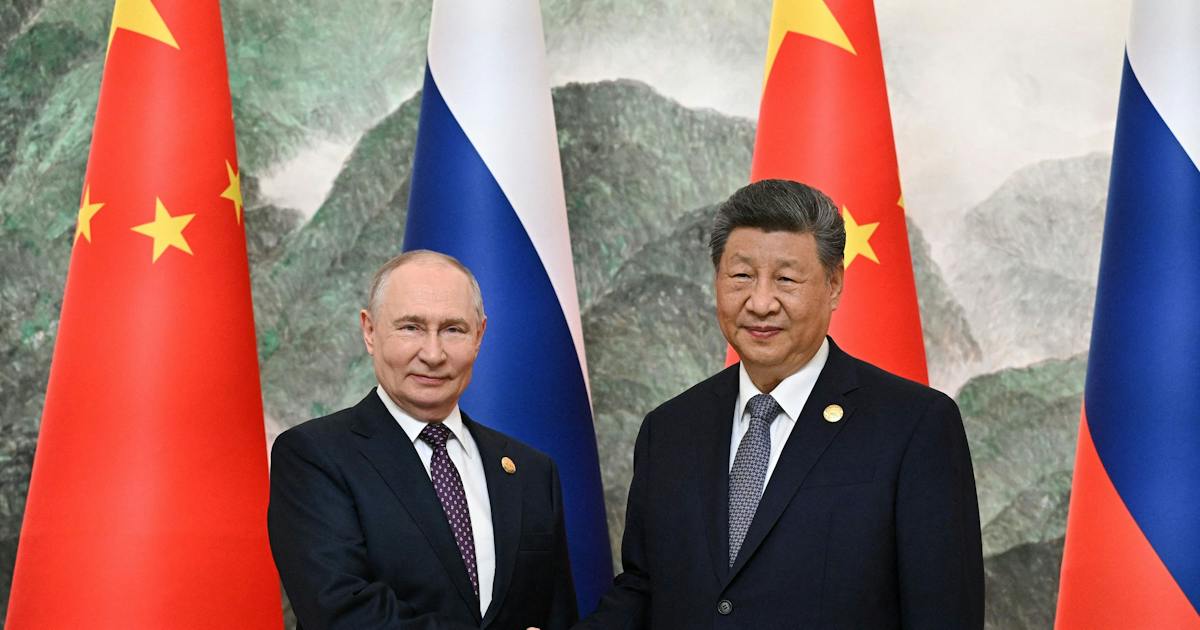
Tripartite dynamics: All eyes are on the scheduled Trump, Xi and Putin meeting on Thursday. China is hesitant to engage in talks on nuclear disarmament, as it has fewer such weapons than the other two, analysts said. It is unclear to what extent, if at all, the Iran war and Russia’s full-scale invasion of Ukraine will be discussed.
China-US relations: Both sides are falling short on commitments to an extended trade truce. Rare earth supplies, AI and tariffs are also likely to figure on the agenda. US arms sales to Taiwan will also be closely watched.
China’s ties with Japan and the Philippines: Strains in Japan and China ties have persisted since Japan’s prime minister Sanae Takaichi angered Beijing in November 2025 by suggesting that Japan could deploy its military if a Chinese move against Taiwan also threatened its territory. China-Philippines relations will likewise be closely watched amid continuing tension in the disputed South China Sea.
During a meeting with Xi Jinping, Mexican president Claudia Sheinbaum said that her country wanted to strengthen cooperation with China in areas related to technology, agriculture, water resources, health and tourism.
The two leaders were speaking in the southern Chinese tech and manufacturing hub of Shenzhen, which is hosting the Apec summit. An annual summit of CEOs is taking place today and tomorrow; while the Apec economic leaders’ meeting is set for tomorrow and Thursday.
As we mentioned in a previous post, hundreds of people have been arrested in heated demonstrations against the arrival of Donald Trump in Manila (expected in an hour or so), with many protesters angry at the new US-led Pax Silica initiative on AI and critical minerals.
The Guardian Australia’s political editor, Tom McIlroy, explains why so many people are rejecting the initiative and provides some details about what it entails:
Pax Silica has sparked tensions in the Philippines over plans to build a tech hub outside Manila that critics say will affect water and energy supplies, and displace members of the Ayta Indigenous community.
Pax Silica will include a technology hub planned at New Clark City in Tarlac, about 120km from Manila.
Intended to bolster western stocks of AI technology and reduce “excessive dependencies” on single source supply chains, including from China, Pax Silica will provide chips and critical minerals to 25 participating signatory governments.
The Philippines president, Ferdinand Marcos Jr, has called for concrete safeguards for food and energy supplies across south east Asia and east Asia in order to protect households and businesses from higher prices caused by global supply disruptions.
He said the impact of conflicts (such as the US-Israel war on Iran) has caused prices and energy costs to rise across the region, hitting consumers hard.
“A disruption thousands of miles away can reach households across east and southeast Asia through the price of rice, the cost of energy, or the loss of a day’s income,” Marcos Jr was quoted as having said. The Philippines president said it is imperative to keep maritime trade and logistics moving and secure essential supplies to withstand shocks.
“Our task today is to put our collective strength to work. In ships reaching their destinations, in reliable supplies of food and energy, in businesses continuing to operate, and in families facing the future with greater confidence,” he said.
China is hosting the summit for the third time, after Shanghai (2001) and Beijing (2014). Both domestic and international reasons govern the choice of Shenzhen, said Chim Lee, senior analyst at the Economist Intelligence Unit.
As part of China’s Greater Bay Area home to Hong Kong and Macau, which Beijing seeks to establish as a global hub for technology and innovation, the city offers a platform to showcase China’s vision for development and trade.
It also highlights Shenzhen’s resilience to geopolitical turbulence, Lee added. Shenzhen is the base for several Chinese auto and tech companies, such as BYD, Huawei and Tencent.
France and Malaysia agree series of deals, including rare earths
France and Malaysia upgraded bilateral ties to a strategic partnership and announced a slew of cooperation deals today, with Kuala Lumpur agreeing to relax export curbs on raw rare earths to support joint development in the sector.
The announcement came following a meeting between French president Emmanuel Macron and Malaysia’s prime minister Anwar Ibrahim in Kuala Lumpur. Macron is on a two-day visit to Malaysia, his first since 2017.
“This renewed partnership will contribute to strengthen our independence on both sides,” Macron said, adding it would also boost the two countries’ defence and security.
Anwar said Malaysia has agreed to export some raw rare earths materials to France following a commitment by Paris to collaborate on rare earths processing.
Interim summary
It has just gone 3pm in Manila (host to the Asean summit) and Shenzhen (Apec). Here’s the main news from both cities so far today. There is plenty more to come so stay with us.
-
China will cut $280m in tariffs on Canadian exports including pork and seafood, Mark Carney’s office said after he met with Xi Jinping. Carney hailed “greater predictability and stability” in China-Canada relations.
-
Canada and China also agreed to extend by two years existing remission measures for certain Chinese steel and aluminium products.
-
Papua New Guinea’s prime minister James Marape confirmed that Taiwan does not operate in the Pacific country anymore, during a meeting with Xi in Shenzhen. “We hope this assists you in your efforts for reunification,” Marape added.
-
Donald Trump is flying on the new Air Force One, gifted to him by Qatar, to Manila where a meeting with Quad leaders is scheduled for later today.
-
Japan has proposed creating a task force to coordinate cooperation in Asia on oil stockpiling and the release of supplies during emergencies – one that will allow neighbours in the region to use idle storage capacity in Japan.







Leave a Reply